Loading...
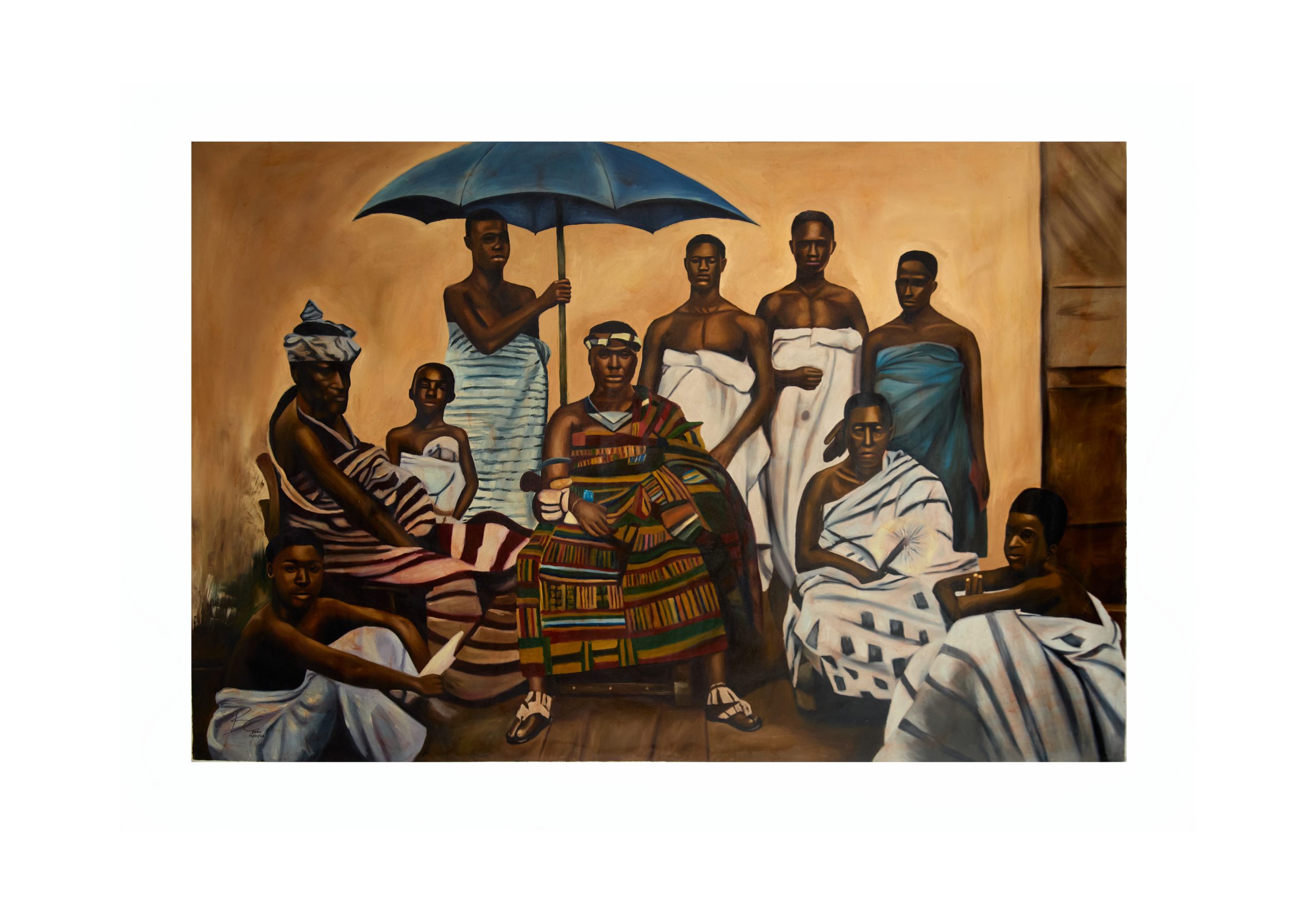
Nana Prempeh 1st Oil on canvas,300x200cm
$60,000
If you're interested in purchasing this artwork, contact me.
Nana Agyemang Prempeh I (around 1872-1931) was a king of the Asante people in Ghana. He became the ruler in 1888 when he was only about 16 or 17 years old. His time as king was full of big events, challenges, and sadness.
He was born around 1872. His mother was Queen Yaa Akyaa, and his father was Kwesi Gyambibi, a son of a previous Asante king. He took over the throne after his older brother, but there were disputes about who should be king. Different groups supported different claimants. Prempeh’s supporters included the Queen Mother and several important chiefs. His rival, Yaw Atwereboana, had support from other chiefs.
In 1888, Prempeh was officially crowned as king in a ceremony with a British officer present. By 1894, he was recognized as the true holder of the golden stool, the symbol of the Asante kingdom. As a young king, he quickly worked to strengthen his kingdom. He fought and defeated a rebellion in Kokofu and started negotiations with neighboring groups to build alliances and expand his influence. He also attacked and took control of Nkoranza to the north and made alliances with other towns to strengthen the empire.
The British were worried about Prempeh’s growing power and a possible alliance with the Mandingo warrior Samory Touré. They had previously fought the Asante in a war from 1873-1874 and wanted to weaken them. The British tried to make Prempeh accept a British official in his land, but he refused, saying Asante should remain independent but friendly with foreigners.
The British didn’t like this and became more aggressive. They saw Prempeh as a threat and decided to remove him. In 1896, British soldiers came to Kumasi, the capital, and Prempeh peacefully surrendered. He promised to pay some gold and accept British protection. But the British had already decided to take control of Asante. They arrested Prempeh, his family, and many chiefs, and sent them into exile first to Elmina, then Sierra Leone, and finally to the Seychelles Islands.
While in exile, he and others were kept away from their homeland. After the Yaa Asantewaa war in 1900-1901, more leaders were exiled to join him. In 1902, the British officially took over Asante and made it a colony.
In 1924, Prempeh was allowed to return home as a private citizen. Most of his supporters had died in exile. The people still saw him as their king, so in 1926, he was officially recognized again as the Kumasihene (chief of Kumasi). When he died in 1931, his nephew Kwame Kyeretwie became the new Asantehene as Prempeh II.
The British later created a political union called the Asante Confederacy in 1935, and Prempeh II became the new Asantehene. However, to the people of Asante, Prempeh I was still their true king, and they never believed he was officially removed. His leadership and resistance played a big role in the history of the Asante people and their fight to stay independent.